
Long time ago I started posting my last summary of my Twitter messages. It is always a nice way to reexperience the developments of a certain time period. For this reason my most important Twitter messages from Ocotber 2014 until January 2015. Read more...
Categories: Design, english, Games, Generative Art, Interaction, mobile, Plants, Programming, Technologie Tags: animation, cool stuff, Design, flash, flex, game design, information design, interface design, internet of things, JavaScript, physical computing, research, video, web, web design, web service
Long time ago I posted my last summary of my Twitter messages, however for me it is always a nice way to reexperience the developments of a time period. For this reason my most important Twitter messages from July 2013 until October 2014. Read more...
Categories: Allgemein, english, Games, Generative Art, Interaction, mobile, Programming, Technologie Tags: cool stuff, image processing, interface design, JavaScript, netzwerk, physical computing, processing, Programming, research, tracking, tutorials, web, web design, webcam

The previous project “Travelling plants” explored the possibilities of connecting digital communication technology with plants. People’s reaction emerged like expected, but the involvement of digital communication technology provides still some space for further experiments. Therefore, the new experiment named “Dead Tree Drop” connects and stores location-based digital data directly on a plant within an urban natural environment. In the course of this thesis the strong relationship between plant-based artwork and its environment were described before. For this reason plants can be associated with local characteristics. Moreover, humans like to stay and rest in natural environments, where they often like to read books and magazines. These initial conditions inspired me to create a physical interface for local-based digital information within natural urban environments.
Read more...
Categories: english, Interaction, My Experiments, Plants, Storytelling Tags: art, Design, interface design, location-based, My Experiments, nature, studium

After the introductions “Visualization techniques with plants” and “Biosensing for Human Computer Interaction” the next projects using some of the already mentioned techniques. However, this chapter focuses on various approaches of network and community designs. Previous Land Art initiatives and projects were always closely tied to social and cultural resonance. These efforts resulted in social activations of local communities and local conditions [KastnerWallis2010, pages 15-28].
Our exploration investigates the application of current technology and design tools in this field. We will start with community design approaches that do not need a physical presence of humans. Design approaches for location-based communities with a supportive use of digital communication technology will be described afterwards.
Read more...
Categories: english, Interaction, Plants, Technologie Tags: art, Design, nature, netzwerk, research, soci, web, web design
After the analysis of “Visualizing techniques with plants”, we will explore interactions for human computer interaction (HCI) through plants. The objectives of this research are revealing technical approaches and which kind of interaction can be performed.
Interactions between humans and computer is usually implemented by sensors. In 2009 Dan Saffer defined a sensor for human computer interaction like this:
A sensor is typically an electrical or electronic component whose job is to detect changes in the environment [Saffer2009, page 13].
We are surrounded by plants and plants are able to sense changes in our environment. The increasing problem with our environment forces us to reconsider our usage of technology. Hybrid solutions between natural resources and our current technology is able to decrease our current environmental issues [ICC2007, pages 15-21]. For this reason, it is obvious to explore the plant abilities of sensing for HCI. The sensor belongs to the basic components of any gestural system, which is used in HCI applications [Saffer2009, page 13]. In our context we replace the common electronic sensor with a plant. An additional electronic circuit translates these bio signals into electronic computer-readable signals. Accordingly to this approach, the gestural system is completed again. Read more...
The artistic research on Human Plant Interface involves a basic understanding of the living organism plants. Botany is the scientific discipline that studies and classifies plants and describes the mechanisms of plants as well as the cultural topics of plants related to humans and nature. Botany is a broad field and not every topic is relevant for Human Plant Interfaces.
This thesis focuses therefore only on a special kind of plant within the kingdom of green plants (Viridiplantae in Latin). This includes multicellular groups as flowering plants, conifers, ferns and mosses, which exist almost all over our environment. Generally spoken, plants have the basic body parts: roots, stems and leaves. Plants of the category green algae and fungi are neglected because of there complicated metabolism. This would go beyond the scope of this thesis.
From the viewpoint of botany the field is still big and for that reason, the following research on plants is focused on the most relevant topics: Plant physiology, plant ecology, ethnobotany and horticulture.
The chapter called physiology describes how a plant senses its environment. The structure of the chapter is based on the human senses, which reveals the similarities and differences between the human and plant perception. The basics of the plant sensor system are important for the following research in visualizing techniques and biosensing applications with plants.
The chapter on plant ecology introduces the interaction between a plant and its environment. Especially the interaction between various species is one important topic. The results are important for the following research on biosensing with plants and the application of locomotion towards plants.
Plants are a crucial element in human culture. The chapter about ethnobotany explores these aspects with a focus on contemporary art projects built with plants. The presented artistic activities hold a strong value for the whole research on Human Plant Interfaces.
The chapter horticulture will provide an introduction into gardening techniques as well as the social aspects of gardening. Both topics have a strong relationship with social design and art. For this reason, this chapter holds some background knowledge for the chapter “3.4. Digital Network and Community Design with plants” on page 85. Moreover, it refers to other artistic approaches like activism and visualizing techniques with plants.
During my research for my master thesis, I got some nice book recommendations about plants, nature, art and environment.
Natural artworks
These books provide a good overview how plants are used in Fine Arts over the last 100 years. Furthermore, it addresses and describes the environmental impacts of these design and art approaches. Pretty useful for an art history overview.
- [Bartel2001] Bartelsheim, Sabine. Pflanzenkunstwerke: Lebende Pflanzen in der Kunst des 20. Jahrhunderts. Schreiber, 2001
- [Nemitz2000] Nemitz, Barbara. trans plant. Living Vegetation in Contemporary Art. Hatje Cantz, 2000
- [KastnerWallis2010] Kastner, Jeffrey; Wallis, Brian. Land and Environmental Art. Phaidon Press, 2010
- [WiMaMe2010] Witzgall, Susanne; Matzner, Florian; Meder, Iris. (Re)Designing Nature - Aktuelle Positionen der Naturgestaltung in Kunst und Landschaftsarchitektur. Hatje Cantz, 2010
- [Haeusler2015] Häusler, Minh. The Fusion of Flora and Art. Hirmer, 2015
- [Ost2015] Ost, Daniel. Der Meister der Blumenkunst. Elisabeth Sandmann Verlag, 2015
- [Wagener] Wagener, Klaus. Architektur und Pflanze: Interior design with plants. Verlag Eugen Ulmer, 2012
- Phaidon editors (2016). Plant: Exploring the Botanical World. Phaidon, 2016.
Categories: Design, english, Generative Art, Interaction, Plants, Programming, Technologie Tags: art, books, Design, inspiration, Interaction, Programming, research
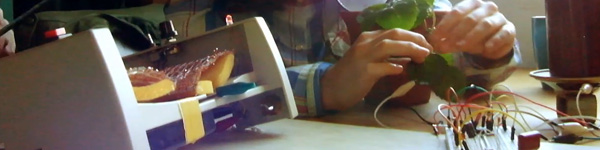
During my research on Human Plant Interfaces I figured out music and sound is a very often used expression for this kind of interaction. As far as I know John Lifton and Richard Lowenberg are one of the first artists that used plants for creating a soundscape. Their installation "Green Music", created for the much discussed movie "The Secret Life of Plants" (movie), uses the approach of bio sensing and converts the signals to synthesized sounds. The visitors can interact with the plants via touch for changing the pitch level of a sound. Read more...
A small summary of my Twitter messages from February 2013- June 2013:
Read more...
Categories: Design, english, Games, Generative Art, Interaction, mobile, Programming, Technologie Tags: art, books, cool stuff, Design, flash, Games, inspiration, Interaction, interface design, physical computing, Programming, tools, tutorials, video, web
During my research on Human Plant Interfaces I stumbled on the book "Nature" published by MIT Press and the Whitechapel Gallery. It is a collection of texts (essays, interviews, etc.) about the Contemporary Art history related to the topic Nature. This book is a nice inspiration source for every artist, scientist, developer who is dealing with nature. In my special case I was mainly interested into plants. You can read a short summary of my readings for my master thesis in Human Plant Interfaces: Read more...